Manipulation
- Learning policies from demonstrations and datasets
- Generalization across objects, scenes, and tasks
- Benchmarking, sim-to-real transfer, and real-robot testing

George Washington University · Mechanical & Aerospace Engineering
Courses connect physical behavior to mathematical models, then use simulation and experiments to test what those models predict.
MAE 4182
Modeling and feedback design for real electromechanical systems, emphasizing stability, performance, and robustness in time and frequency domains.
Visible derivations and interactive browser experiments help students connect equations to system response—and defend what each model predicts.
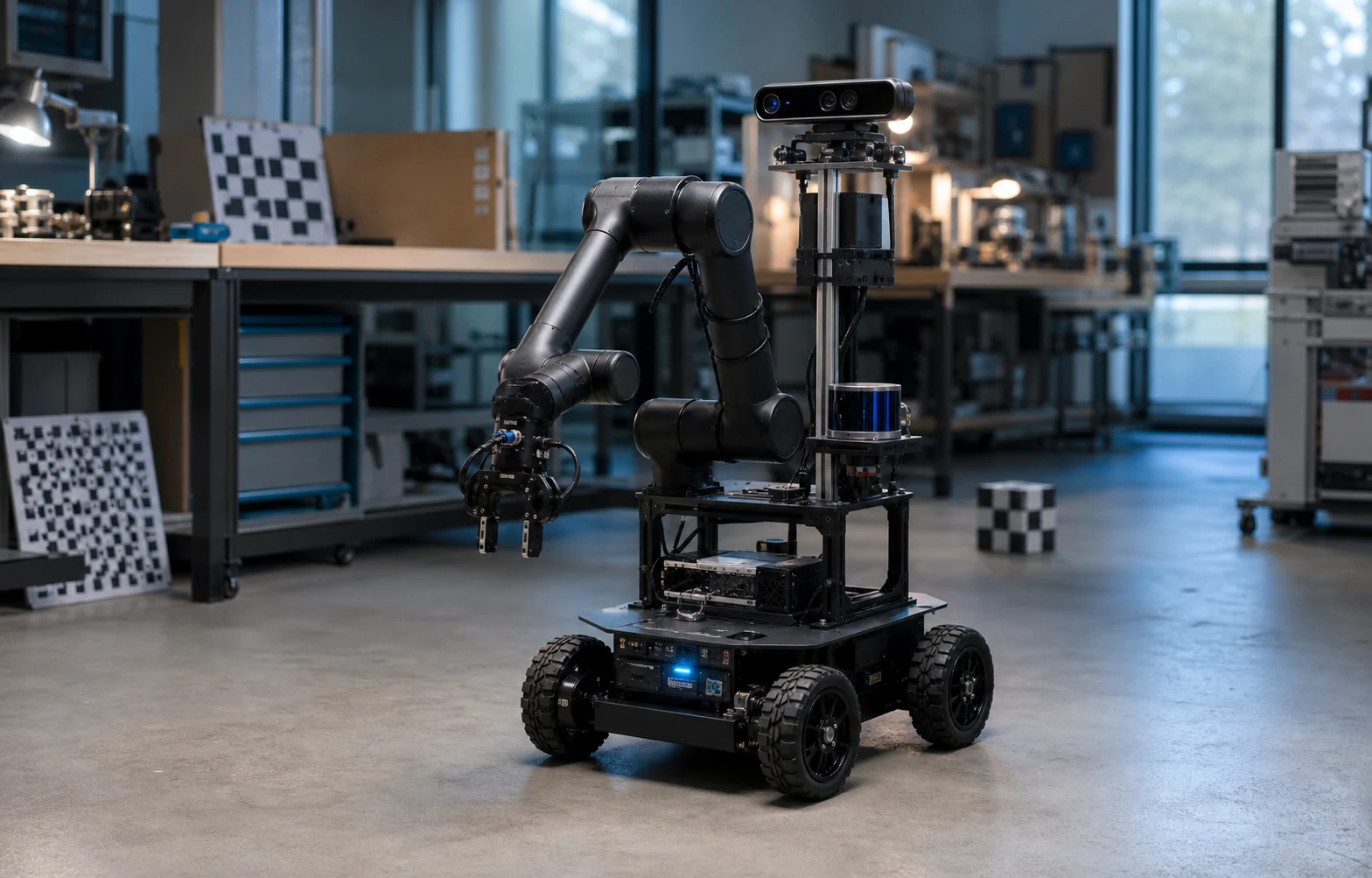
A systems-level introduction to how robots sense, reason, and act under uncertainty.
Dynamics and control, sensing and vision, estimation, planning, and learning are studied as one connected pipeline.
View the Spring 2026 courseInside MAE 6245
Small modeling, sensing, and decision errors can compound through the pipeline. Students make assumptions explicit, reason about uncertainty, and evaluate system behavior rather than treating each module in isolation.
The class is research-oriented, with critical reading, student-led paper discussions, and a semester-long open-ended project. Related project topics are welcome with instructor approval.
Selected course tools
Reference platforms used to explore robotics pipelines, learning, and localization.